
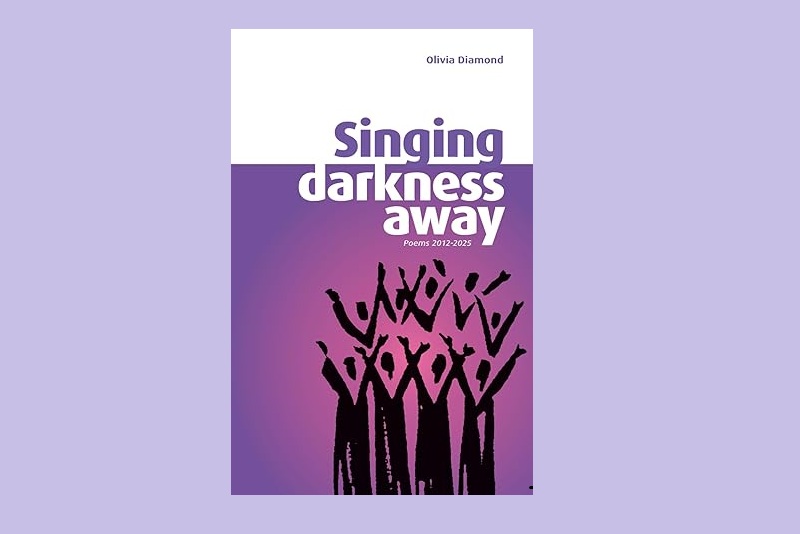
How does poetry sing darkness away in the tumultuous past five years during which two horrible wars began—Russia’s attack on Ukraine and the Israeli genocidal war in Gaza? On the home front, I gasped in horror at the rise of fascism in the United States. I took solace in poetry because art is the first line of defense against tyranny. Art pierces the darkness in the worst of times, exposing lies, encouraging, and inspiring even though evil seems to overpower virtue. Plays, songs, statues, and paintings arise to counteract false narratives.
Singing is akin to poetry because they both arrange sound. The shaping of poems requires a meditative state. Begun in silence, the process of crafting a poem creates order out of chaos and dissonance, singing the darkness away and seeing hope emerge. Light does break through; the darkness is dispersed through the poetic action of sound and sense. Just as a choir singing in harmony shapes harmonious sound, so does the art of poetry.
“Three Choirs,” the first poem in the collection sets the tone and my underlying intent to harmonize and unify in an era of disharmony and divisiveness.
Choirs exist to sing the darkness away.
Because the parts have to blend together
They must work for harmonious union.
It’s the perfect place for peace and release
From dismay when social discord triumphs.
I wished to withdraw to my interior castle,
Pull up the drawbridge and let no tyrant
Cross over the moat into my inner sanctum.
To preserve my sanity, I craved insulation
From the lunacy set loose on the nation.
I could sing my lament in my tower alone
Or join three choirs to live through the time
When chaos and graft are allowed to rule.
A better plan is to sing joyfully with others.
The toads can croak together in their swamp.
This eclectic collection reflects upon sights and experiences from ordinary life as well as political events, the reality of progress, the affluent society, overdevelopment, and natural disasters. Some poems explore concepts like humility, justice, and hope. Other poems turn to themes of aging and the loss of friends and family through death. Observation of nature furnishes an ever-present source of consolation and meaning. The darkness lifts further with whimsical poems that treat of subjects like jelly beans and alligator meat.
Both free verse and traditional forms are included. The term “free verse” is a misnomer, because crafting of sound and sense are no less required than they are in formal verse. The absence of rhyme and meter does not liberate the poet from the necessity to shape and mold words and lines through other means such as parallelism, alliteration, assonance, and imagery. Art is not a smattering of paint on a canvas nor is cacophony music. Arranging broken prose lines on a white page is not poetry. The crafting endows the words with the name of art, and through that activity, I quelled my distress.
The practice of poetry, as all art forms, produces serenity. It disperses the darkness; it sings darkness away; it replaces gloom and doom with a lightness of being despite that evil seems to overshadow virtue. Through poetry, the sister of song, I can see “hope eternal, loath to ever disappoint” and pronounce that “leaping like a lady, she holds up her green lamp.”


