
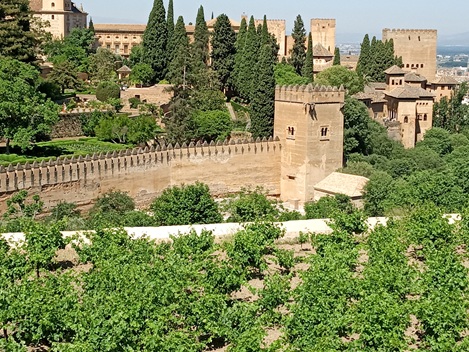
Although distant in time and geography, ethnic cleansing in 16th century Spain is an important story for 21st century Americans. Few may know about it in the list of ethnic cleansings that have occurred over recorded history. After the Spanish conquest of Granada, the last bastion of Islamic rule in southern Spain, in 1492 a large Islamic population remained. The conquerors were not interested in co-existence but in imposing Catholicism upon the entire nation.
The Spanish Jews were first given the royal ultimatum to either convert to Christianity or suffer forced deportation. In 1523, Carlos V reneged on the terms of the 1492 surrender, which granted religious and cultural freedom to the Moslems of Granada and gave them the same ultimatum the Jews had received. Mass baptisms of the Moors ensued. The prohibitions against wearing Moorish clothing, practicing Islamic customs, and speaking Arabic were suspended for forty years, purportedly to allow for cultural and religious assimilation. Under Philip II the mandates were re-imposed resulting in the rebellion of the Moriscos in the War of the Alpujarras 1568-1570. After the defeat of the Moriscos, Philip ordered the dispersal of the surviving Moriscos to other regions of Spain—a strategy to prevent a concentration of Moriscos that would be capable of armed revolt again. Throughout the 16th century the converted Moriscos were suspect. Religious and secular leaders feared they were a third column within the country conspiring with the Ottoman Empire to reconquer Spain for the Islamic world. After decades of debate and suspicion, Philip III ordered the final expulsion of Spain’s Moriscos in 1609. Miguel Cervantes de Saavedra witnessed this process. Indeed, he was writing the second half of El Ingenioso Hidalgo Don Quijote de La Mancha during this removal and must have seen caravans of Moors under guard being marched to the sea ports for transport to North Africa.
The Spanish monarchy’s ethnic cleansing carried out over more than a century is not the first occurrence of ethnic cleansing the world has seen and probably not the last. The last century witnessed more instances of ethnic cleansing committed in Armenia, Germany, Croatia, Palestine, and Rwanda. Today we see it happening again in Gaza. The measure of a democracy is how the dominant majority treats its ethnic minorities.
My book of narrative poetry, Al-Andalus published in 2015, is the precursor to this novel. After I completed my research of Moslem Spain from 711 to 1609, I was overwhelmed with the amount of material on Islamic Spain. With such a rich trove of information, I did not know where to begin. Since I do not write sagas, I turned to what I knew best—writing dramatic monologues. The panoply of historical characters and events percolated in my imagination over several years until in 2014 I focused my attention of a Morisco family in Granada at the onset of the rebellion. I created the fictional De Luna family to dramatize the Moriscos’ struggle to preserve their religion, language, and culture under Spanish domination. In that way, I could make history personal, portraying exactly how the actions of the powerful regime effect the daily lives of ordinary people.
Through a blend of historical fact and imaginative truth, I aimed to depict the ethnic cleansing that occurred in sixteenth century Spain. The De Lunas typify what happened to the Islamic population of Granada, the last bastion of Islamic rule in southern Spain. In Leila de Luna’s words, “If our fellow countrymen could understand Islam, they could not commit the crimes they do. When I read the Bible and the Koran, I see the similarities.”
Leila’s hope is also mine, that readers will see the same similarities and realize that the two religions share common tenets of peace, compassion, charity, and the brotherhood of mankind. Along with this understanding, I would wish readers to draw parallels with other instances of ethnic cleansing around the world and perceive how such campaigns of national purification or homogenization are antithetical to democracy.